The beginning of a journey
The history of the Grand Lodge of Cyprus is the record of a journey through our own Masonic space and time. It began on 8 October 2006, when the first harmonious knocks of the gavels resounded at the Famagusta Gate, in the Venetian walls of Nicosia; it continues still, reaching towards the future, and has now completed its first twenty years. Like every true journey, it is measured not only by the distance travelled, but by what the traveller has become along the way.
On that day a new Temple of Virtue was raised, bearing as its emblem the three orders of architecture and the three Great Pillars: the Ionic of Wisdom, the Doric of Strength and the Corinthian of Beauty.
These Pillars do not merely support a building; they govern every act of the Freemason, in thought, in word and in deed.
Cypriot Freemasonry had laboured for many decades within wider Masonic frameworks. In time, as fruit ripens on the branch, the conditions matured for a stage of its own, and for an Orient of its own.
4 December 2005 stands as a landmark. On that day the Founding and Constitutional Assembly of the Cypriot Lodges, which were then working under the Auspices of the Grand Lodge of Greece, was convened and, in a spirit of historical awareness and Masonic responsibility, resolved to found the Grand Lodge of Cyprus. On 15 January 2006 the First General Assembly of the Grand Lodge of Cyprus was convened. It elected as first Grand Master Bro∴ Iakovos (Ivikkos) Vorkas, together with the first Grand Council of the Grand Lodge of Cyprus. That election was not merely the elevation of individuals to office; it was the acceptance of a high mission: to safeguard the Order and to advance Freemasonry in the land of Cyprus.
As already mentioned, the official Consecration of the Grand Lodge of Cyprus took place in Nicosia on 8 October 2006. The Sponsor and Consecrating Officer was the Grand Master of the Grand Lodge of Greece, M∴ W∴ Bro...Spyridon Paizis; the co-sponsors were the Grand Master of the Grand Lodge of Pennsylvania, in the United States, M∴ W∴ Bro∴ Ronald Aungst, Sr., and the Grand Master of the Grand Lodge of Austria, M∴ W∴ Bro∴ Michael Klauss.
8 October 2006 was a day of ritual fulfilment and of historical vindication. On that day the toil of many years took visible form, and the Grand Lodge of Cyprus took its place on the map of regular Grand Lodges as a sovereign and independent Masonic Authority.
The years that followed vindicated this course. Through strenuous and patient effort, the Grand Lodge of Cyprus gained wide international recognition, for what is built in truth sooner or later finds its witnesses.
Symbolic roots in Cypriot soil
The age-old history of “the sweet land of Cyprus” provided the firm ground upon which deep foundations could be laid, so that the edifice of the Grand Lodge of the Cypriot Freemasons might stand. When we dig into the “Cypriot earth”, we bring symbolically to light the origins of universal Freemasonry, which have been sought, by various paths, in the ancient rites and Mysteries of the Greeks and the Egyptians. These origins are offered not as proof of an unbroken historical descent, but as a symbolic reference: they allow the collective memory of the Cypriots to recall places, myths and legends of their own, in which a most ancient initiatic tradition lies concealed. For the initiate knows that the search for Light is older than any institution that has ever sheltered it.
The mind travels first to the Sanctuary of Apollo Hylates at Kourion, one of the most important ancient places of worship in Cyprus, where the cult of the god is attested as early as the eighth century BC.
It travels, too, to the Egyptian Pharaoh Thutmose III, who is said to have brought Cyprus under his dominion in the middle of the fifteenth century BC and who, according to tradition, initiated certain persons so that the practice of the Egyptian Mysteries might continue on the island.
The historical approach, for its part, links the development of Freemasonry with the Roman colleges of builders. From these, in time, arose the builders’ fraternities of the Middle Ages, and through them the speculative system of Masonry, or Freemasonry as it is known today, gradually took shape. The passage from the operative builder to the speculative Freemason is, in a sense, the passage from the stone of the building to the stone of the soul; from the rough ashlar of the quarry to the perfect ashlar of the inner temple. Of that passage Cyprus bears rich testimony.
Public and religious buildings survive on the island which connect the medieval tradition of building with the presence of operative masons. The imposing Cathedral of St Nicholas, within the walls of Famagusta, a work of the early fourteenth century, is among the most characteristic examples. So too are the so-called Twin Churches of Famagusta, traditionally attributed to the Knights Templar and the Knights of St John, whose first building phase dates from the thirteenth century, with later additions in the fourteenth.
Particular mention is due to Bellapais Abbey, near Kyrenia, raised in the thirteenth century by canons regular living under the Rule of St Augustine.
At Kolossi, the castle held by the Knights Hospitaller from 1210 passed briefly, in 1306, into the possession of the Templars. After the suppression of the Order of the Temple, the Tower returned to the Hospitallers, only to be destroyed in 1425-26 during the raids of the Mamluks of Egypt. Upon the ruins of the old Tower, the present Tower was built in 1454 by the Grand Commander of the Hospitallers, Louis de Magnac.
Thus, within the history of universal Freemasonry, bound as it is to the wider medieval tradition of building, Cyprus may recognise in the course of its own history the traces of a Masonic presence. The birth of universal Freemasonry in its modern, organised form is conventionally placed in 1717, with the founding of the first Grand Lodge of England.
The first traces
The late Bro∴ Georgios Papacharalambous, Worshipful Master of Lodge “Solon” of Nicosia in 1938-1939, citing a manuscript of 1751 that belonged to Petrakis Karidis, a member of the well-known Karidis family of Larnaca, placed the beginnings of a Masonic presence in Cyprus at the end of the eighteenth century. To the same family belonged Christodoulos Karidis, secretary of the French Consulate in Larnaca from 1756 to 1788, and Konstantinos Karidis, later Athanasios, Metropolitan of Nicomedia, who was hanged in 1821 together with the Ecumenical Patriarch Gregory V.
The Karidis manuscript bears the phrase: “...this is the property of a Mason, the property of Petrakis...”. Although no Lodge is named, the phrase indicates that already by the end of the eighteenth century there were persons in Cyprus who described themselves, or were described by others, as Masons. It is not, however, sufficient in itself to establish the existence of an organised Lodge or of any other constituted Masonic body.
Bro∴ Georgios Papacharalambous also refers to an encyclical of 2 February 1815, issued by the then Archbishop of Cyprus, the martyr Kyprianos, against the “many freemasons who have appeared in the town of Skala and Larnaca”.
This encyclical, known as the Encyclical against the Masons, is preserved to this day in the archives of the Holy Archbishopric of Cyprus. Its very existence testifies that, at the beginning of the nineteenth century, the presence of persons described as Freemasons was already known in Cyprus; for no one issues warnings against a shadow.
A further significant indication is provided by the nineteenth-century gravestones bearing engraved Masonic symbols which survive in the precinct of the Church of Saint Lazarus in Larnaca. Characteristic is the gravestone of Michael de Vezin, British consul in Aleppo and vice-consul in Larnaca, on which the square and compasses can clearly be seen. Stone, which outlasts the hands that carve it, here preserves strong and silent evidence of his Masonic identity. These testimonies are not, of course, sufficient to prove the existence of a fully organised Freemasonry in Cyprus at that time. The prevailing historiographical view places the establishment of organised Masonic Lodges on the island after the British occupation of 1878 and, more particularly, with the founding in Limassol in 1888 of the first Lodge, St Paul’s Lodge No. 2277, under the Auspices of the Grand Lodge of England.
The first Lodges
St Paul’s Lodge No. 2277 is mentioned in the work “History of Organised Cypriot Freemasonry”, published in 1948 by the late Bro∴ Christoforos Tornaritis, a physician, who served as Grand Inspector of the Symbolic and Philosophical Lodges of Cyprus under the Auspices of the Grand Lodge of Greece. Tornaritis records that “on 5/5/1888 there took place at the camp of Polemidia, among English Freem∴, a meeting for the founding in Cyprus of a Mas∴ L∴, which took on flesh and bone on 2/11/1888 under the name St Paul (St Paul’s Lodge).”
The same Lodge is also mentioned in a publication of the United Grand Lodge of England of 1967, issued to mark the 250th anniversary of the founding of the first Grand Lodge of England in 1717. Among the founders of St Paul’s Lodge was John Percy White, an English secretary serving with the British army. His efforts were not confined to filling the Lodge with English servicemen and British residents of the island; he also sought the participation of Cypriots, and so helped to build the first bridges between the British and the Cypriot Masonic worlds. The Craft has always known that bridges, no less than temples, are the work of builders.
To this context belongs Dr Ioannis Karageorgiades, a member of St Paul’s Lodge. He had been initiated into Freemasonry as early as 1865 in Athens, in Lodge “Panhellenion No. 1”, and he was destined to play a leading role in the further development of the Craft in Cyprus. The founding of Lodge “Zenon” in Limassol in 1893 is linked to his initiative and activity; later there followed Lodges “Kimon” in Larnaca, in 1918, and “Solon” in Nicosia, in 1921.
The founding of “Zenon” was thus a new and particularly important milestone in the course of Cypriot Freemasonry. P. V. Hadjipanos, in his work “Greek Freemasonry 1740-1950”, writes characteristically: “The L∴ Zenon No. 18 in Limassol, founded in November 1893, is the first Lodge in Cyprus under Greek Auspices, at the request of 14 Brethren, ardent patriots, under the auspices of Bro∴ Ioannis Karageorgiades.” Its founding joined Cypriot Masonic life to the Greek-speaking Masonic tradition and opened a new path for the development of Freemasonry on the island.
The road to “Zenon” had, however, begun some years earlier. On 20 January 1890 Bro∴ John Percy White sent an exploratory letter to Bro∴ S. Stefanou, then Grand Secretary General of the Grand Orient of Greece, asking whether there would be any obstacle to founding a Greek Lodge in Cyprus under the Auspices of the Grand Orient of Greece. The reply, given under the Grand Mastership of Bro∴ Nikolaos Damaskinos, was immediate and favourable. This development did not pass unnoticed by the Grand Lodge of England, which regarded Cyprus as part of its own Masonic jurisdiction. The founding of a Greek Lodge was therefore not simply a matter of a new Masonic presence; it raised the question of jurisdiction and, more deeply, the question of the very identity of Freemasonry in Cyprus. Beyond the issue of which Grand Lodge should exercise its Auspices, a wider question now arose: whether Cypriots would be able to approach Freemasonry in their own language, and according to their own ethos and spiritual character. It was, at bottom, the ancient question of every seeker: whether the Light may be received in one’s mother tongue.
Invoking the principle of nationality, which the Grand Lodge of England had itself used as the basis for founding Lodges under its Auspices in countries where British subjects resided, the Grand Lodge of Greece proceeded to the Consecration of the first Greek Lodge in Cyprus, Lodge “Zenon” No. 18, in the Orient of Limassol, on 15 November 1893.
The founding of “Zenon” did not remain an isolated event. In the years that followed, Greek Freemasonry in Cyprus acquired a more stable presence and spread across the island. Greek-speaking Lodges were founded in Larnaca, Nicosia, Paphos and Famagusta, gradually forming a wider Masonic network.
This development soon went beyond mere organisational growth. With the creation and consolidation of the Lodges, a distinct Cypriot Masonic body gradually took shape, with its own historical experience, its own needs and its own course; a course which, after decades of labour and maturing, would at last lead to the founding of a Grand Lodge of its own.
In order of foundation, the Greek-speaking Lodges that were founded and worked under the Auspices of the Grand Lodge of Greece, and that later contributed to the formation of the Grand Lodge of Cyprus, were the following:
1. Lodge “Kimon”, consecrated in Larnaca on 7 October 1918, which today works under the Auspices of the Grand Lodge of Cyprus as No. 1.
2. Lodge “Solon”, consecrated in Nicosia on 18 July 1921, which today works under the Auspices of the Grand Lodge of Cyprus as No. 2.
3. Lodge “Kinyras”, consecrated in Paphos on 23 June 1923, which today works under the Auspices of the Grand Lodge of Cyprus as No. 3.
4. Lodge “Evagoras”, consecrated in Famagusta on 18 March 1928, which today works under the Auspices of the Grand Lodge of Cyprus as No. 4.
5. Lodge “Adonis”, consecrated in Nicosia on 12 November 1961, which today works under the Auspices of the Grand Lodge of Cyprus as No. 5.
6. Lodge “Koinon Kyprion”, consecrated in Nicosia in 1977, which today works under the Auspices of the Grand Lodge of Cyprus as No. 6.
7. The English-speaking Lodge “Phoenix”, consecrated in Nicosia on 26 October 1995, which chose to join the District Grand Lodge of Cyprus of the United Grand Lodge of England, where it works as No. 9817.
Lodge “Zenon” No. 18, for its part, continued to work under the Auspices of the Grand Lodge of Greece. Its history, however, always remained an inseparable part of the wider memory of Cypriot Freemasonry; and on 22 May 2022 it too came under the Auspices of the Grand Lodge of Cyprus, as a long-awaited Brother returns at last to his own hearth.
The road to sovereignty
The question of the institutional organisation of Freemasonry in Cyprus began to be discussed among Cypriot Freemasons as early as the beginning of the 1980s. Two options gradually emerged at the centre of the discussion: on the one hand, the founding of a District Grand Lodge of Cyprus within the framework of the Grand Lodge of Greece; on the other, the creation of a fully independent Grand Lodge of Cyprus, a sovereign Masonic Authority in its own right. The first official discussion took place in Athens on 30 January 1988, during the General Assembly of the Grand Lodge of Greece. It had, however, no immediate sequel. The prospect of a Grand Lodge in Cyprus was still regarded with reserve, chiefly for reasons of a national character.
The matter returned officially in 1996, with a specific proposal for the founding of a District Grand Lodge of Cyprus. The proposal was submitted by the delegation of the Cypriot Lodges to the General Assembly of the Grand Lodge of Greece on 27 January 1996, following a special meeting of the Worshipful Masters, Representatives, Inspectors and Deans of Cyprus, held in Limassol on 15 January 1996.
From that point onwards, the path towards the institutional autonomy of Cypriot Freemasonry entered a long and gradual process. The District Grand Lodge was the immediate and institutionally feasible solution within the framework of the Grand Lodge of Greece; full independence was a wider prospect, which would require a different institutional development. This distinction is essential for understanding the events that followed. Here, as so often in Masonic life, patience proved to be not the opposite of resolve, but its most mature form.
On 15 September 1998, at a meeting of Inspectors and Deans, it was resolved to send a Memorandum to the Grand Lodge of Greece proposing that its Constitution and General Regulations be amended, so as to allow for the founding of a District Grand Lodge in Cyprus.
Two years later, at the Constitutional General Assembly of the Grand Lodge of Greece on 14 October 2000, the revision of the Constitution and General Regulations was approved, providing for the founding of a District Grand Lodge of Cyprus.
This created the institutional basis for the next step. On 31 October 2001, at a meeting in Athens between the Council of the Grand Lodge of Greece and the Cypriot Deans, the Deans submitted a complete proposal for the founding of a District Grand Lodge of Cyprus.
By Decree No. 42623, dated 22 November 2001, the Grand Lodge of Greece called for a ballot in all the Lodges of Cyprus, among all their members (Entered Apprentices, Fellow Crafts and Master Masons), on three options:
a) the founding of a Grand Lodge of Cyprus;
b) the founding of a District Grand Lodge of Cyprus;
c) remaining under the Auspices of the Grand Lodge of Greece. The result was a large majority in favour of remaining under the Auspices of the Grand Lodge of Greece, while the other two options received very small percentages.
On 16 October 2002, in Athens, at the annual joint meeting of the Council of the Grand Lodge of Greece with the Inspectors and Deans of the Cypriot Lodges, the Cypriot Inspectors and Deans questioned the validity of the ballot, on the ground that Entered Apprentices and Fellow Crafts had taken part in it. Their reasoning was that Brethren of the first two Degrees could not yet be sufficiently familiar with the concepts and terms involved in the founding and working of a Grand Lodge of Cyprus. They therefore requested the immediate founding of a District Grand Lodge in Cyprus. This request set in motion a new process of decision. At its meeting of 26 February 2003, the Council of the Grand Lodge of Greece resolved to send a Decree to all the Lodges of Cyprus, so that a definitive position might be reached at meetings held in the Degree of Master Mason.
A series of meetings and consultations among the Cypriot Worshipful Masters, Inspectors and Deans followed. The positions of the Lodges were finally set out in a letter dated 17 July 2003. Five Lodges, “Zenon” No. 18 of Limassol, “Kimon” No. 53 of Larnaca, “Kinyras” No. 64 of Paphos, “Evagoras” No. 77 of Famagusta and “Koinon Kyprion” No. 126 of Nicosia, declared themselves in favour of founding an independent Grand Lodge of Cyprus.
The opposite position was taken by Lodge “Adonis” No. 115 of Nicosia, in an official letter dated 13 July 2003 which, among other things, spoke of a “defection” on the part of the five Lodges that had declared for an independent Grand Lodge of Cyprus.
Lodge “Solon” No. 55 of Nicosia likewise took a negative position, in an official letter dated 20 October 2003, stating, among other things, that “Greek Cypriot Freemasonry must be preserved in the protective embrace and the keeping of the Grand Lodge of Greece”. Lodge “Phoenix” No. 136 of Nicosia took no position.
The discussion then moved to the General Assembly of the Grand Lodge of Greece on 31 January 2004, where the representatives of the Cypriot Lodges declared themselves in favour of an independent Grand Lodge of Cyprus. Of particular significance was the fact that Lodge “Solon”, departing from its earlier position, now declared itself in favour of independence.
The matter was examined again on 18 February 2004, at a special meeting at the Masonic Hall of Larnaca, presided over by the Grand Master, M∴ W∴ Bro∴ Spyridon Paizis, with all the Lodges of Cyprus taking part. The subject was discussed at length, but no specific decision was taken. The Grand Master concluded that the Grand Lodge of Greece proposed and supported the founding of a Grand Lodge of Cyprus, but that the final decision rested with the Lodges of Cyprus themselves; a wise acknowledgement that freedom, to be real, must be exercised by those to whom it belongs.
This position opened a new institutional path. At its meeting of 5 April 2004, the Council of the Grand Lodge of Greece resolved to found a District Grand Lodge, as an intermediate and preparatory step towards an independent Grand Lodge of Cyprus.
This transitional solution, however, was not to be the final outcome. At the meeting of 15 September 2004 the position of the Grand Lodge of Greece changed, and it was now decided that an independent Grand Lodge of Cyprus should be founded without delay. The new position was conveyed to Cyprus on 18 September 2004, during the visit of the Assistant Grand Master, Bro∴ Nikos Vourgidis, and the Grand Orator, Bro∴ Leonidas Papadopoulos, who asked the Lodges of Cyprus to submit their positions by 30 October 2004.
Of the eight Lodges of Cyprus, three replied. Lodge “Zenon” of Limassol, by official letter of 30 October 2004, declared itself in favour of an independent Grand Lodge of Cyprus; Lodge “Evagoras” of Famagusta, by official letter of 22 October 2004, in favour of a District Grand Lodge; and Lodge “Solon” of Nicosia, by official letter of 21 October 2004, in favour of leaving matters as they were. Despite these divergent positions, the process moved forward. At its meeting of 10 November 2004, the Grand Lodge of Greece unanimously reaffirmed its support for the majority of the Cypriot Lodges, which favoured the immediate founding of an independent Grand Lodge of Cyprus.
To ascertain the will of the Lodges definitively, a new secret ballot was held on 12 March 2005, at meetings in the Second Degree in all the Lodges of Cyprus, so that each Lodge might decide for or against the founding of a Grand Lodge of Cyprus. The result clearly reflected the new balance.
Six Lodges, “Zenon”, “Kimon”, “Kinyras”, “Evagoras”, “Adonis” and “Koinon Kyprion”, voted in favour of founding a Grand Lodge of Cyprus; among them was “Adonis”, which less than two years earlier had spoken of “defection”. Three of the six reached their decision unanimously, and the other three by a large majority. Lodge “Solon”, at its meeting in the Second Degree on 9 March 2005, had voted against the founding of a Grand Lodge of Cyprus: of the 31 members who voted, 19 were against and 12 in favour. Lodge “Phoenix” decided to abstain.
Yet the position of “Solon” was not to remain final. Before the Founding and Constitutional Assembly, which had been scheduled to take place in Limassol on 4 December 2005, Lodge “Solon” held an emergency meeting in the Second Degree on 28 September 2005 and proceeded to a new secret ballot. This time it declared itself in favour of founding a Grand Lodge of Cyprus, with 20 votes in favour out of 29 members voting. So it is with every living body of Brethren: minds are not compelled, but persuaded, and true consensus is the one that ripens from within.
Thus the conditions were created for the decisive act. The Founding and Constitutional Assembly of the Grand Lodge of Cyprus finally took place on 4 December 2005, at the Masonic Hall of Nicosia. Six Lodges were present: “Kimon” of Larnaca, “Solon” of Nicosia, “Kinyras” of Paphos, “Evagoras” of Famagusta, “Adonis” of Nicosia and “Koinon Kyprion” of Nicosia.
“Zenon” of Limassol, despite its earlier position in favour of a Grand Lodge of Cyprus, was not present, and “Phoenix” of Nicosia was likewise absent.
The Consecration
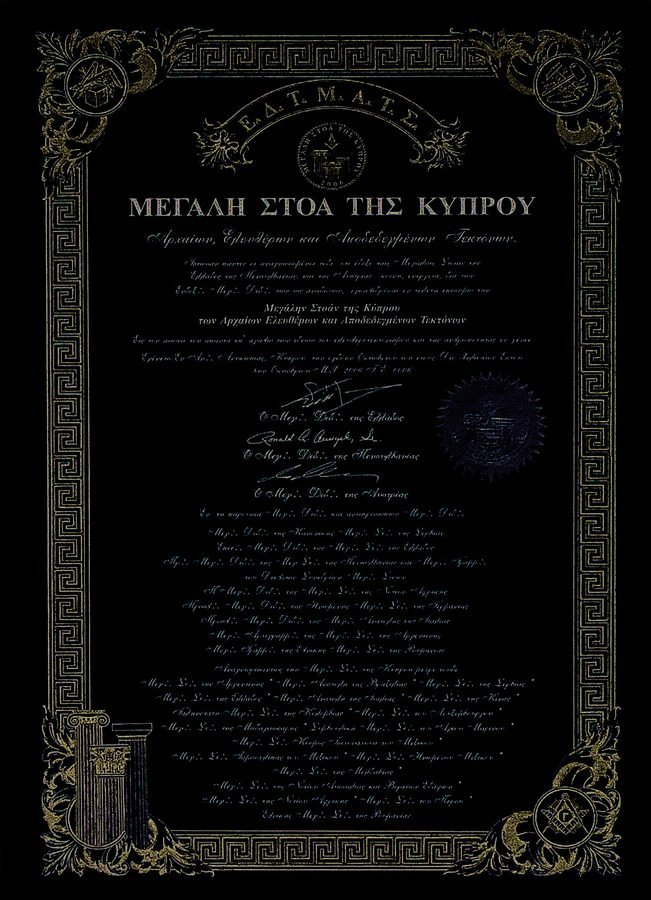
At the Constitutional General Assembly of 4 December 2005, the founding of the Grand Lodge of Cyprus was decided unanimously by the six Lodges present, and the Constitution and General Regulations were approved at the same time. That decision became the cornerstone upon which the edifice of the Grand Lodge of Cyprus was to be raised.
The next step was to constitute the new Masonic Authority. On 15 January 2006 the First General Assembly of the Grand Lodge of Cyprus was convened and elected as its first Grand Master Bro∴ Iakovos (Ivikkos) Vorkas. Elected as members of the first Council were Bro∴ Andreas Assiotis, as Assistant Grand Master, together with Bro∴ Panagiotis Ioannou, Savvas Pilakoutas, Adamos Komodromos, Antonis Neofytou, Haroutioun Arakelian, Athanasios Papadopoulos, Kyriakos Neokleous, Panagiotis Vavlitis and Christodoulos Kyperountas.
Subsequently, the Grand Master of the Grand Lodge of Greece, M∴ W∴ Bro∴ Spyridon Paizis, by Decree dated 1 February 2006 addressed to all the Lodges under its Auspices, announced the decision of the Council of the Grand Lodge of Greece, taken at its meeting of 27 January 2006, to recognise the Grand Lodge of Cyprus, which had been founded on 15 January 2006 by resolution of the First General Assembly.
With this recognition, another important stage on the road to the full institutional constitution of the new Grand Lodge was completed. The founding decision now bore the official recognition of the Grand Lodge of Greece, opening the way for the solemn Consecration of the new Masonic Authority. The mother Grand Lodge had blessed the departure of her daughter; and in Freemasonry there is no truer independence than that which is granted in brotherly love. And so, on 8 October 2006, at the Famagusta Gate in Nicosia, the official ceremony of the Consecration of the Grand Lodge of Cyprus took place. The Sponsor and Consecrating Officer was the Grand Master of the Grand Lodge of Greece, M∴ W∴ Bro∴ Spyridon Paizis.
The co-sponsors were the Grand Master of the Grand Lodge of Pennsylvania, in the United States, M∴ W∴ Bro∴ Ronald Aungst, Sr., and the Grand Master of the Grand Lodge of Austria, M∴ W∴ Bro∴ Michael Klauss.
8 October 2006 thus became the ceremonial and historical culmination of a course begun many decades earlier. The consultations, the differing approaches, the decisions and the successive institutional milestones had at last led to the official Consecration of the Grand Lodge of Cyprus.
With that ceremony, Cypriot Freemasonry acquired its definitive institutional form as an independent Grand Lodge. And with independence it assumed a new responsibility: to safeguard the tradition it had received, to serve regularity, and to build its way into the future in full awareness of its past.
Its historical course is, above all, a course towards Light. It is the passage from searching to constitution, from desire to responsibility, from the seed to the tree. And, like every true Masonic work, the Grand Lodge of Cyprus continues to build, with Faith in the G...A...O...T...U∴, Hope in Immortality and Charity towards all Mankind.
The second decade
With the completion of its first decade, in 2016, the first cycle in the history of the Grand Lodge of Cyprus came to its close. The star that had risen in 2006 continued its course across the vault of heaven, leading the Order into the second decade of its history. If the first decade had been the time of laying the foundations, the second would be the time of raising the pillars: the time in which the edifice, proved by the square and laid out by the compasses, would lift its roof towards the sky and open its gates to the world.
The dawn of this second decade broke in the Orient of Nicosia on 7 February 2016 when, under the gavel of the Most Worshipful Grand Master, M∴ W∴ Bro∴ Petros Machalepis, the tenth Annual General Assembly was convened. Before turning to the future, the Order turned its gaze to the past and bowed in memory of the Most Worshipful and Right Worshipful Brethren Ivikkos Vorkas, Andreas Assiotis, Athanasios Papadopoulos, Christodoulos Themistokleous, Ioulios Stavrinides and Haroutioun Arakelian, who, having laboured faithfully within the Temple, had passed to the Eternal East. The flame of their memory lit the Labours of that day, and has lit every page of our history ever since. For in Freemasonry the departed are not absent; they have only gone ahead of us, to the Lodge that is never closed.
Then, with its gaze turned towards the approaching milestone, the Assembly announced the completion of the first decade of the Grand Lodge of Cyprus and the celebrations that would mark it. The course of the second decade continued on 21 January 2018, when Masonic time marked another important moment of handing over and taking up. Before one hundred and fifty-two Brethren, the twelfth Annual General and Electoral Assembly honoured the outgoing Grand Master, M∴ W∴ Bro∴ Petros Machalepis, who, looking back on his three-year term, assured the Brethren that he would always remain present, at the side of the new Council. The same Assembly honoured the craftsmen of the ritual renewal, the Brethren who had hewn the new Rituals of the First, Second and Third Degrees, as well as those who served the charitable and secretarial work of the Order, some of whom were proclaimed Honorary Grand Officers.
And when the vote of the Brethren raised R∴ W∴ Bro∴ Andreas Charalambous, unopposed, to the highest office, the Temple lived one of its most sacred moments. The new Grand Master was conducted beneath the arch of steel formed by five sword-bearers, to the sound of the gavels; he took the customary obligation and was installed in the Chair of King Solomon.
The new ten-member Council, serving under the Grand Master with R∴ W∴ Bro∴ Chrysanthos Chrysanthis as Assistant Grand Master, took up the responsibility of carrying the work forward. Its pledge that all the Brethren would work united expressed its commitment to the common work; a pledge that was kept, and is still kept, in full.
The first year of the new Grand Mastership soon bore fruit. The thirteenth General Assembly, on 2 February 2019, heard the account of a year built upon four pillars: internal organisation, intellectual work, external relations and international presence. Concord and harmony prevailed constantly within the Council, and its meetings breathed a spirit of self-examination and constructive criticism, for the true Freemason begins by working upon his own rough ashlar. The crowning achievement of the year, however, was charity. A cheque for ten thousand euros was presented to the Shriners, the fruit of a major charity event organised with great success by Bro∴ Kostas Paraskevaidis. It was further practical proof that the light of the Temple is not kept within its walls, but pours out towards a suffering world.
In the same year the Order bowed before a centenary. Lodge “Kimon” completed one hundred years of life and service, and the Grand Master addressed to it the grateful greeting of the whole Order. A century in the life of a Lodge is a chain of generations: each Brother a link, and the chain still unbroken.
The fourteenth General Assembly, on 8 February 2020, found the Grand Lodge at the height of its outward-looking activity. The Grand Master announced that fifteen years were being completed since its founding, and that this milestone would culminate in two days of celebrations, presenting the Order to the profane world as well. The most important historical announcement of that day, however, was another: the Grand Lodge of Cyprus had by then been recognised by almost one hundred and sixty Grand Lodges on five continents. The small island of Aphrodite had taken its place on the world Masonic map, the fruit of the tireless efforts of the Grand Master and the members of the Council. From that position, the Grand Lodge of Cyprus had itself extended recognition to two Grand Lodges in Brazil.
In the same year the blood-donation programme “Drops of Life” was instituted: Freemasonry in the service of life, in the most literal sense. At the same time, translations of the regulations for the foreign-language Lodges were being prepared, together with an information pack for newly initiated Brethren. The growth in membership, it was stressed, was not an end in itself, but the fruit of the faithful observance of the Rituals and the Regulations.
The Grand Master closed with a wish that, unknown to all at the time, was to acquire a particular significance: “love, peace and calm, so that we may carry out our work as Freemasons”.
A few weeks later, this course was interrupted by an unprecedented trial. The global storm of the pandemic silenced the Temples and suspended the gathering of the Brethren in person. In 2021 the Annual General Assembly could not be convened in its full ceremo nial form. Only the Financial Report and the Almoner’s Report were presented, on 23 October 2021, as a plain but eloquent testimony that, even in the most adverse conditions, the administrative constancy and the charitable heart of the Order never ceased, even for a moment, to beat.
The Freemason, even when the Temple is silent, continues to hew his stone. Silence, too, is a teacher of the Craft.
And the Temple opened once more. On 19 February 2022 the sixteenth General Assembly (the sixteenth, even though the previous one had not been convened, for Masonic time does not lose its count) marked the return to normality.
The Grand Master, speaking of the wounds of the pandemic and of the inability of the internet to replace the sacredness of meeting in person, did not dwell on lamentation; he announced works. First came a Solidarity Fund for Brethren in difficulty and the creation of a Charitable Foundation under the Auspices of the Grand Lodge: brotherly love was taking institutional form. There followed the reactivation of the Masonic Academy, for intellectual work is the daily bread of the Freemason. Further objectives were set: the creation of a Masonic Shop, the installation of an internal communication system, the strengthening of financial order, and attendance at more than half of the meetings as a condition for the right to elect and to be elected. Even uniformity of dress, down to the gloves and the ties, belonged to the same conception: care both for the larger design and for the smallest detail, as befits builders.
International relations were conducted with the same sense of responsibility. The recognition of the Grand Lodge of Pará, in Brazil, and of the Grand Lodge of Georgia was approved, and the number of Grand Lodges recognising the Grand Lodge of Cyprus stood at the impressive figure of 178.
There was, however, one moment that sealed that Assembly in the memory of all present, and it was at once the smallest and the greatest of all. The entire contents of the Trunk of Beneficence were given to little Katerina, so that she might travel to Germany for treatment. In that Trunk, filled with humble offerings, the whole meaning of Freemasonry and of the Order found room.
29 January 2023 brought the seventeenth General Assembly, and with it the close of another cycle. The M∴ W∴ Grand Master Andreas Charalambous, deeply moved, looked back on the five years of his Grand Mastership, years of consolidation, of trial and of transcendence, and paid tribute to his Council, which had stood around him in an unbroken spirit of concord and harmony.
He handed over his office leaving behind a solid body of work: the recognition of the Grand Lodge by more than one hundred and sixty Grand Lodges abroad; the institution of “Drops of Life” and of the charity dinner, for which he thanked Bro∴ Michalis Agathos∴ and the extensive effort to modernise the General Regulations and the Constitution, whose fruits were to be presented to a forthcoming Constitutional Assembly.
At the same Assembly, Bro∴ Spyros Petrakides was honoured for his service to Cypriot Freemasonry, while R∴ W∴ Bro∴ Andreas Sofokleous was proclaimed Honorary Grand Treasurer. Mention was also made, with gratitude, of the excellent work of the outgoing Grand Treasurer, R∴ W∴ Bro∴ Marios Poufos.
The Assembly further resolved to increase the number of Grand Officers by one, so that the Council would henceforth have eleven members for the three-year term 2023-2026. Unopposed, the highest office was conferred upon R∴ W...Bro∴ Chrysanthos Chrysanthis.
Once again the arch of steel, the five sword-bearers and the sounding gavels; once again the obligation, the Chair of King Solomon and the threefold proclamation. The outgoing Grand Master, certain that he was handing the office to a worthy successor, able to raise the standard higher still, assured him that he would always remain at his side, exactly as his own predecessor had done five years before.
Thus is the Light transmitted: from hand to hand, without ever being extinguished.
The new Assistant Grand Master, R∴ W∴ Bro∴ Michalis Agathos, pledged on behalf of the new Council both work and unity for the good of the Grand Lodge.
Now under the gavel of the M∴ W∴ Grand Master, Bro∴ Chrysanthos K. Chrysanthis, the eighteenth General Assembly, on 3 February 2024, witnessed a smooth and fruitful transition into the new era. The Grand Master read the first report of his term, reviewing the work that had been accomplished. The budget was forecast to show a surplus, and all the reports were approved unanimously. That unanimity was not a mere formality; it was the voice of a healthy body.
The nineteenth General Assembly, on 29 January 2025, confirmed that calm, too, is an achievement. The year, as the Grand Master observed while thanking his Council for its excellent cooperation, had passed quietly, without serious problems in the Lodges. Yet calm did not mean inactivity. The publication, in ritual form, of the Masonic Funeral Service and of the Lecture on the Tracing Board of the Entered Apprentice Degree was announced, so that both might be included in the reissue of the Rituals of the Masonic ceremonies. The ritual heritage was to be handed on to the coming generations more complete than it had been received. The Worshipful Masters were also asked to contribute material and photographs to the “Tracing Board”, for memory, too, must be built.
The same Assembly presented the programme of the International Conference of the “Giuseppe Garibaldi” Lodges, which took place from 7 to 9 March 2025 with great success. The gathering brought together in Cyprus Brethren from different Masonic jurisdictions and marked another important milestone in the international presence of the Grand Lodge of Cyprus, confirming that Cyprus was nolonger merely a recipient of international Masonic brotherhood, but also a place of meeting, of dialogue and of common work. The chronicle of the General Assemblies, however, records only the summits. The greater part of a decade’s work is accomplished in silence: in the meetings of the Council, in the secretariats of the Lodges, in the registers and in the annual reports. Before this chronicle reaches its end, therefore, it is fitting to turn our gaze to that unseen edifice as well; for, as every builder knows, the foundations bear the weight precisely because no one sees them.
The unseen edifice
In 2016 the Grand Lodge of Cyprus numbered thirteen Symbolic Lodges of Blue Masonry and five hundred and two members, Entered Apprentices, Fellow Crafts and Master Masons, spread across the Orients of Nicosia, Larnaca, Limassol, Paphos and refugee Famagusta. By the close of the decade the Lodges numbered seventeen, and the strength of the Order had at times exceeded six hundred and sixty members. This growth was never pursued as an end in itself, as was repeatedly stressed from the East; it came as the natural fruit of the seriousness of the Labours and of the radiance of the Order towards the world outside.
Within this decade four new pillars were raised in the edifice. In 2017 the English-speaking Lodge “Perseas No. 14” was founded in the Orient of Nicosia, opening the Order to the foreign-language Brethren who live and work on the island. There followed, in the Orient of Limassol, Lodge “Unity No. 15” and Lodge “Ippokratis No. 16”, while the historic Lodge “Zenon No. 18” came to stand beside them under the Auspices of the Grand Lodge of Cyprus. These three hearths of light made Limassol a second great centre of Cypriot Freemasonry, and vindicated the foresight of earlier years in acquiring a permanent Masonic home in the city.
A special place in this course belongs to the resumption of work, in 2023, of the Italian-speaking Lodge “Giuseppe Garibaldi No. 8”, which had first begun its labours in 2008 and which brought back into the active Masonic life of Cyprus a tradition of deep roots and strong international character. Its reawakening widened still further the openness of the Grand Lodge towards the foreign-language and international Masonic communities, and added another link to the historical bond between Cyprus and Italian Freemasonry.
And if some older Lodges, owing to the circumstances and conditions of their time, fell dormant, the Order never ceased to regard them as its own. For in Freemasonry sleep is not death, but the awaiting of an awakening.
The life of the Lodges, as recorded year by year in the annual reports, was full and substantial: hundreds of regular meetings each year in the three Degrees; initiations of new members; ceremonies of passing and raising to the Degrees of Fellow Craft and Master Mason; and, perhaps most important of all, a steady river of lectures and papers which kept the lamp of Masonic learning burning. Alongside these, white and joint meetings, solstitial festive boards, charity dinners and fraternal visits between the Lodges bound the Orients of the island into a single fraternal chain. And that chain extended its links beyond the sea. Lodge “Kimon” was twinned with Lodge “Amaranthys” in the Orient of Chania, and the refugee Lodge “Evagoras” with Lodge “Pistis” in the Orient of Piraeus, while “Giuseppe Garibaldi” represented Cyprus at the world celebrations of the Lodges bearing that name, at Trapani in Italy. These were the tesserae of a single mosaic: an outward-looking spirit, cultivated systematically, which year by year extended the fraternal presence of the Grand Lodge of Cyprus beyond the shores of the island. At the summit of the administrative edifice, the Council of the Grand Lodge met without interruption, holding thirteen or fourteen regular and emergency meetings a year, and its decisions were transformed, with a discipline that does the Order credit, into circulars, letters and decrees, the date of execution almost always recorded beside the date of decision. There were years in which almost the whole work of the Council was devoted to a single great purpose. In 2016, for instance, as the annual report expressly testifies, a significant part of the Labours was devoted to planning and organising the celebrations of the first decade.
There were also years in which the Council was called upon to govern in the midst of the storm. During the pandemic, by successive decrees, it suspended and resumed the Labours of the Lodges, protecting first the health of the Brethren and then, as soon as conditions allowed, the sacred continuity of the Labours. The administrtion did not stop for a single day; and that, at a time when everything around was being suspended, was in itself an achievement. The decade was also a period of modernisation. As early as 2016 the objective was set of creating a digital archive of the Grand Lodge, containing historical documents and photographs from the events of the Order and of its Lodges, and of systematically ordering the books, documents and archives of the secretariats. Provision was also made for gathering the circulars in force into a single handbook for Worshipful Masters.
This effort matured gradually and bore rich fruit in the last years of the decade. The General Regulations and the Constitution were revised and sent for reprinting; the Rituals of the Degrees were checked and reissued; the publication of the Rituals in English was set in motion for the benefit of the foreign-language Lodges; a new Ritual for the Installation of Officers was prepared; and the “Tracing Board” entered the electronic age.
The crowning achievement of this modernisation was the new website of the Grand Lodge, with an integrated electronic newspaper and digital library. The Order, faithful to its traditions, proved once again that it does not fear the tools of its age, but places them in the service of its work, as the operative masons of old never refused a better chisel, provided the hand that held it remained true.
And while within the island the edifice was being made firm, beyond it the Order’s name travelled far. The patient and methodical work for international recognition, letter by letter and treaty by treaty, reached towards the end of the decade a figure that would have seemed inconceivable to the founders. With the completion of mutual recognition with the Grand Lodge of Bosnia and Herzegovina, the number of Grand Lodges in mutual recognition with the Grand Lodge of Cyprus rose to one hundred and seventy-three, in seventy-six countries of the world. Small Cyprus now held its place as an equal member of the world Masonic family.
This work, too, had its own craftsmen. Three Grand Secretaries General held, in turn, the pen and stylus of the Order during the decade: R∴ W∴ Bro∴ Konstantinos L. Agrotis, during the Grand Mastership of Petros Machalepis; R∴ W...Bro...Aristotelis A. Komodromos, during that of Andreas Charalambous; and R∴ W∴ Bro∴ Antreas K. Asprou, during that of Chrysanthos Chrysanthis. They were supported by the Grand Officers, the Grand Inspectors and the secretariats of the Lodges, which year by year prepared and submitted their reports.
To all of them, and to all who serve unseen the good order of our Fraternity, this album owes a special word of gratitude. For administration, in Freemasonry, is not bureaucracy; it is service: the square that keeps the lines true and the level that keeps the courses even, so that the building may rise secure.
Twenty years on
The profane sees only the Temple; the Freemason knows how many stones, how many hands and how much order were needed for it to rise.
And so the Order reached the year 2026, the year of the great milestone: twenty years since the founding of the Grand Lodge of Cyprus. Twenty years from the day on which a few visionary Brethren raised in Cyprus a pillar of Masonic light, to the day on which its name is honoured on five continents.
Thus the second decade, too, was completed: a decade of maturity, in which the Grand Lodge of Cyprus celebrated its birth, renewed its Rituals, joined its name to the offering of blood and of love, won recognition on five continents, was tested in the furnace of the pandemic and emerged from it stronger.
Three Grand Masters, M∴ W∴ Bro∴ Petros Machalepis, M∴ W∴ Bro∴ Andreas Charalambous and M∴ W∴ Bro∴ Chrysanthos Chrysanthis, received and handed on the gavel in harmony, building upon the foundations laid by those who went before them. If this chronicle teaches anything to those who may read it in years to come, it is this: the stone is hewn slowly, but the Temple rises steadily. Time, which wears away every work of human hands, is for the Freemason not an adversary but a fellow-workman; what is well built is not consumed by the years, but proved by them. And so long as the Brethren labour with Wisdom, Strength and Beauty, and depart from their Labours always in peace and in discretion, the Great Architect of the Universe will not cease to shelter the work of their hands.
This album, published on the occasion of this anniversary, is not a mere record of achievements. It is an offering of the spirit and a legacy to the ages to come; and from this Orient we charge it with Masonic Light and brotherly love.
The Grand Masters
- Iakovos (Ivikkos) VorkasFirst Grand Master, from 2006
- Panagiotis M. IoannouHonorary Grand Master
- Petros MachalepisHonorary Grand Master, until 2018
- Andreas Chr. CharalambousHonorary Grand Master, 2018–2023
- Chrysanthos ChrysanthisGrand Master, from 2023
Text from the anniversary album “Grand Lodge of Cyprus 2006–2026”. Editorial committee: Michalis G. Agathos, Christakis Melides, Polydoros Papaiacovou, Nikolas G. Sarlis, Iosif Hadjikyriakos.